Born rule in vector notation
The chapter now turns amplitudes into probabilities. The key point is that normalization plus orthonormality already force the coefficients in a state expansion to behave like probability amplitudes. The Stern-Gerlach screen then provides the physical interpretation: probability is measured by the relative amount of beam intensity in each output channel.
Write the state in an orthonormal basis:
The state must satisfy \(\langle\Psi|\Psi\rangle=1\). Substituting the expansion gives
Using orthonormality \(\langle n|m\rangle=\delta_{nm}\), only equal-index terms survive:
The coefficient \(C_n\) is the projection amplitude \(\langle n|\Psi\rangle\). The probability of finding the system in the state \(|n\rangle\) is its squared modulus:
This is the Born rule in vector notation. The probability is not the amplitude itself, because amplitudes can be negative or complex. The measurable probability is the squared modulus.
The same probability can be written with a projector:
This form is useful because it connects the probability postulate with the operator language. A measurement channel is represented by a projector, and the probability is the expectation value of that projector.
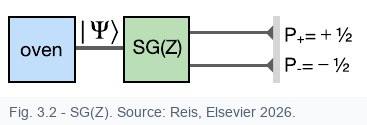
Suppose the electron spin state in the silver beam is
The projection amplitudes onto the SG(Z) eigenstates are
Therefore
In the apparatus, this means equal intensities in the two output beams.
The probabilities do not fully specify the state. Two states may have the same probabilities in one basis and still differ by phases that affect a later measurement in another basis. This is why matrix mechanics keeps amplitudes until the moment a measurement probability is needed.
This page is designed to support short guided exercises on: Postulate of probability: amplitudes are inner products, and probabilities are squared moduli of projections.
- Use from this page: the definitions, physical setup, highlighted equations and conceptual links needed to start a first calculation or explanation.
- Keep in the book: complete derivations, extended historical discussion, worked solutions and the full textbook narrative remain in the original chapter and linked book resources.
- Good exercise balance: ask the student to identify assumptions, apply one relation, and interpret the result physically, without requiring material not introduced on this page.
Use these anchors to design compact exercises. The exercise should be answerable from this page plus standard algebra, while longer derivations, full worked examples and broader context should point back to the original book.
- Focus: Postulate of probability: amplitudes are inner products, and probabilities are squared moduli of projections.
- Conceptual check: state what the main result says physically before using it algebraically.
- Equation: \[|\Psi\rangle=\sum_n C_n|n\rangle.\]
- Equation: \[\langle\Psi|\Psi\rangle=\left(\sum_n C_n^*\langle n|\right)\left(\sum_m C_m|m\rangle\right)=\sum_{n,m}C_n^*C_m\langle n|m\rangle.\]
- Equation: \[\sum_n |C_n|^2=1.\]
- Boundary: use this page for setup and first-step reasoning; cite the book for longer derivations, complete experimental history or solved-problem detail.
- Typical task: derive, interpret, or apply the relation above to a simple case without introducing topics outside this page.