Commutators, compatibility and measurement order
The chapter now uses the Stern-Gerlach setup to give physical meaning to non-commuting operators. If two observables do not commute, their measurement order matters. A measurement in one basis can prepare a state that is no longer sharp in the previous basis.
The commutator of two operators is
For the spin matrices constructed earlier,
Multiplying in the two orders gives different matrices, so
This algebraic nonzero result means that the same basis cannot diagonalize both operators.
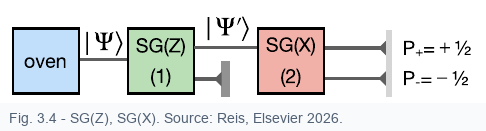
First, an SG(Z) device prepares the state \(|\Psi'\rangle=|+\rangle\). If the second device is aligned along \(x\), this state must be rewritten in the \(x\)-basis:
The Born rule then gives
A state that was definite for SG(Z) is not definite for SG(X).
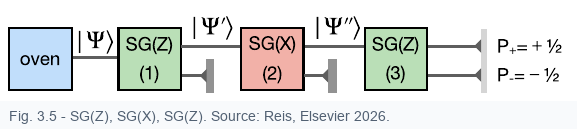
Now select the \(x\)-up beam after the second apparatus. The state entering the third device is
For the final SG(Z), rewrite this state in the \(z\)-basis:
Thus the final SG(Z) probabilities are again
The middle SG(X) measurement destroyed the certainty produced by the first SG(Z) selection.
When two observables commute, they can share eigenvectors and can be sharp simultaneously. When they do not commute, a state prepared as an eigenstate of one observable is generally a superposition in the eigenbasis of the other.
This is the physical meaning of non-commutation in the chapter: it is not only an algebraic statement. It predicts what happens when real measurement devices are arranged in sequence.
The SG(Z)-SG(X)-SG(Z) sequence is one of the clearest ways to understand quantum measurement. The first device prepares a state; the second asks an incompatible question and prepares a new state; the third shows that the original sharp information is no longer present.
For two observables, the commutator compares the two possible orders of action. If the two orders differ, the order of measurement can matter physically:
In the Stern-Gerlach sequence, SG(Z) prepares a \(z\)-eigenstate. SG(X) then asks an incompatible question and prepares an \(x\)-eigenstate. A final SG(Z) no longer receives the original \(z\)-eigenstate.
That story is what an exercise should test: algebraic non-commutation, basis change and state preparation are three views of the same phenomenon.
This page is designed to support short guided exercises on: Non-commuting spin components, compatible observables and why an intermediate measurement can erase information.
- Use from this page: the definitions, physical setup, highlighted equations and conceptual links needed to start a first calculation or explanation.
- Keep in the book: complete derivations, extended historical discussion, worked solutions and the full textbook narrative remain in the original chapter and linked book resources.
- Good exercise balance: ask the student to identify assumptions, apply one relation, and interpret the result physically, without requiring material not introduced on this page.
Use these anchors to design compact exercises. The exercise should be answerable from this page plus standard algebra, while longer derivations, full worked examples and broader context should point back to the original book.
- Focus: Non-commuting spin components, compatible observables and why an intermediate measurement can erase information.
- Conceptual check: state what the main result says physically before using it algebraically.
- Equation: \[[\hat A,\hat B]=\hat A\hat B-\hat B\hat A.\]
- Equation: \[\hat\sigma_z=\begin{pmatrix}1&0\\0&-1\end{pmatrix},\qquad \hat\sigma_x=\begin{pmatrix}0&1\\1&0\end{pmatrix}.\]
- Equation: \[[\hat\sigma_z,\hat\sigma_x]\ne0.\]
- Boundary: use this page for setup and first-step reasoning; cite the book for longer derivations, complete experimental history or solved-problem detail.
- Typical task: derive, interpret, or apply the relation above to a simple case without introducing topics outside this page.