Expectation value, variance and preparation
Probabilities tell how often outcomes occur. Expectation values summarize the average result in an ensemble, while variance measures how dispersed those results are. The Stern-Gerlach sequence in the book then adds a crucial measurement idea: selecting one output beam prepares a new state.
If the possible results of \(\hat A\) are \(a_n\) with probabilities \(P_n\), the ensemble average is
Using \(P_n=|\langle n|\Psi\rangle|^2\), this can be rewritten step by step:
The sum in parentheses is the spectral decomposition of \(\hat A\), so
The variance of an observable is the expectation value of the square minus the square of the expectation value:
A zero variance means that repeated measurements on identically prepared systems give the same result. In other words, the state is sharp with respect to that observable.
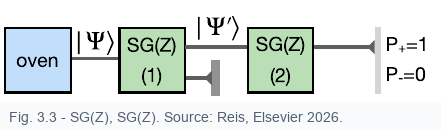
Start with the balanced state \(|\Psi\rangle=(|+\rangle+|-\rangle)/\sqrt2\). The first SG(Z) device separates the two beams. If the \(-\) beam is blocked, the surviving beam is no longer the original superposition. It must be renormalized to
This state enters the second SG(Z) device.
Because the prepared state is already an eigenstate of \(\hat\sigma_z\), the second SG(Z) measurement is certain:
The expectation value is
Also, since \(\hat\sigma_z^2=\hat 1\),
The example is the experimental face of the measurement postulate. After a result is selected, the state is projected into the corresponding eigenstate. A later device does not interact with the old superposition; it interacts with the newly prepared state.
This is why the blocked beam is not a minor detail. It changes the preparation, and therefore changes the probabilities for all later measurements.
Expectation value, variance and projection are three views of the same measurement structure. First compute the outcome probabilities, then average the eigenvalues, and finally interpret what state is left after an outcome is selected.
This page is designed to support short guided exercises on: Ensemble averages, uncertainty of an observable and how repeated Stern-Gerlach measurements prepare a state.
- Use from this page: the definitions, physical setup, highlighted equations and conceptual links needed to start a first calculation or explanation.
- Keep in the book: complete derivations, extended historical discussion, worked solutions and the full textbook narrative remain in the original chapter and linked book resources.
- Good exercise balance: ask the student to identify assumptions, apply one relation, and interpret the result physically, without requiring material not introduced on this page.
Use these anchors to design compact exercises. The exercise should be answerable from this page plus standard algebra, while longer derivations, full worked examples and broader context should point back to the original book.
- Focus: Ensemble averages, uncertainty of an observable and how repeated Stern-Gerlach measurements prepare a state.
- Conceptual check: state what the main result says physically before using it algebraically.
- Equation: \[\langle\hat A\rangle=\sum_n P_n a_n.\]
- Equation: \[\langle\hat A\rangle=\sum_n \langle\Psi|n\rangle\langle n|\Psi\rangle a_n=\langle\Psi|\left(\sum_n a_n|n\rangle\langle n|\right)|\Psi\rangle.\]
- Equation: \[\langle\hat A\rangle=\langle\Psi|\hat A|\Psi\rangle.\]
- Boundary: use this page for setup and first-step reasoning; cite the book for longer derivations, complete experimental history or solved-problem detail.
- Typical task: derive, interpret, or apply the relation above to a simple case without introducing topics outside this page.