Delta well: transmission and reflection
Take the zero-width limit, \(a\to0\), of the finite potential well with \(E>0\). Region II is suppressed and the potential becomes \(V(x)=-\alpha\delta(x)\). The goal is to determine the transmission and reflection coefficients for a particle incident from the left.
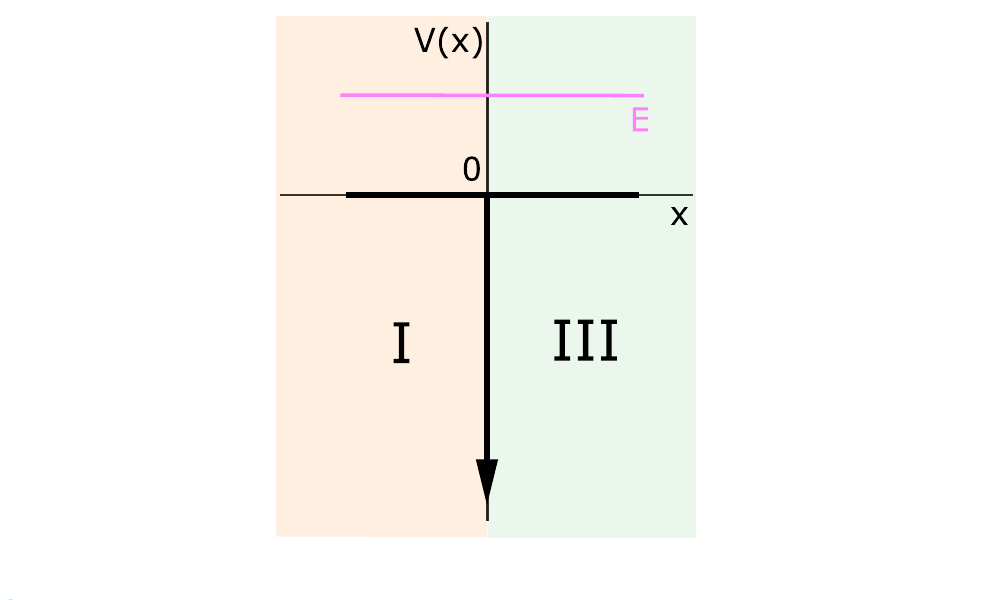
The coefficients \(A\), \(B\), and \(F\) follow from the boundary conditions at \(x=0\).
The derivative relation is obtained by integrating the Schrödinger equation across the interface.
Integrating from \(-\epsilon\) to \(+\epsilon\) and taking \(\epsilon\to0\) gives the derivative on the left of the interface minus the derivative on the right:
Before taking the limit, the regional derivatives are
Thus, when \(\Delta x\to0\),
Using \(\psi(0)=A+B\) in the derivative relation, together with \(A+B=F\), yields
The coefficients obey \(R+T=1\). The larger the ratio \(|E|/\mathcal E'\), the greater the transmission probability.
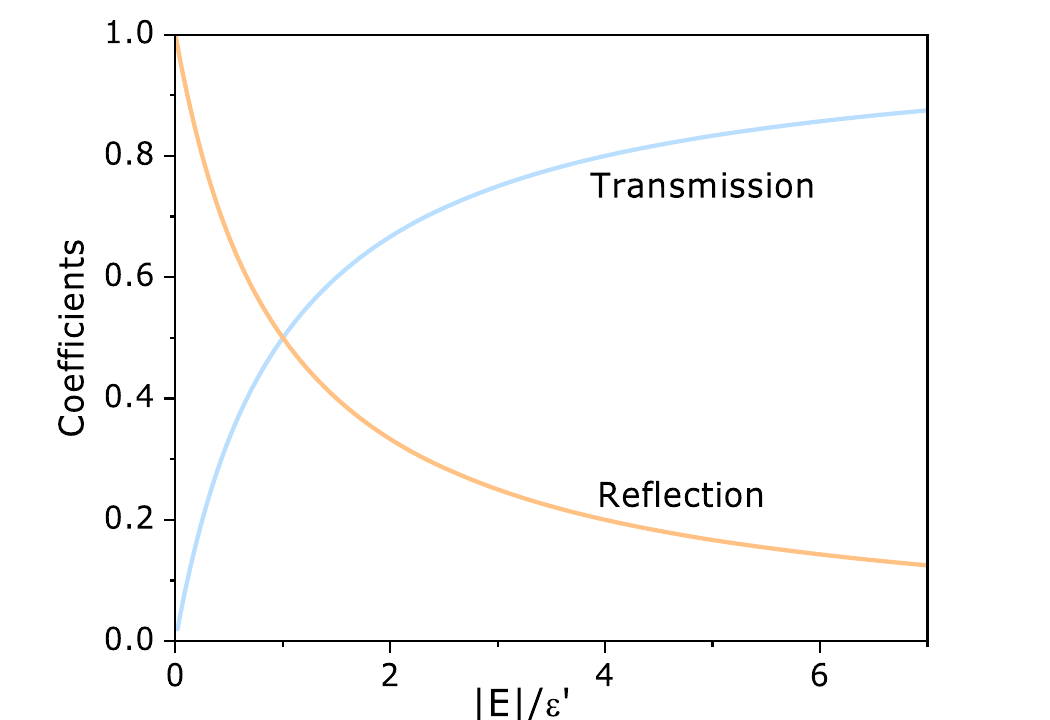
For \(V(x)=\alpha\delta(x)\), a delta-type barrier, the transmission and reflection coefficients are the same as for the delta well when the incident particle has \(E>0\).
This page supports guided exercises on the positive-energy delta-well scattering calculation.
- Use from this page: regional wave functions, the interface conditions, \(\mathcal E'\), and the coefficients \(T\) and \(R\).
- Keep in the book: the complete integral calculation across the delta interface.
- Good exercise balance: apply continuity and the derivative relation before forming \(T\) and \(R\).
Use these anchors to build compact exercises from the delta-well scattering calculation.
- Focus: positive-energy scattering from \(V(x)=-\alpha\delta(x)\).
- Conceptual check: identify the incident, reflected, and transmitted amplitudes.
- Key equation: \[T=\frac{1}{1+\mathcal E'/|E|},\qquad\mathcal E'=\frac{m|\alpha|^2}{2\hbar^2}\]
- Boundary: use the displayed conditions to set up the calculation; use the book for the complete interface integration.
- Typical task: obtain \(T\), \(R\), and verify \(R+T=1\).