Finite potential well: bound-state setup
The finite well is divided into three regions. The bound-state range \(-V_0<E<0\) gives exponential wave functions outside the well and oscillatory wave functions inside it. The boundary conditions at \(x=0\) and \(x=a\) connect these three solutions.
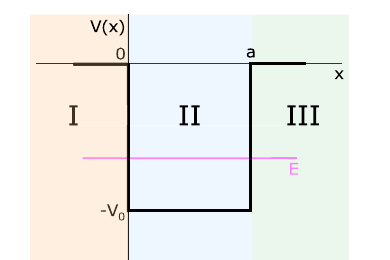
The energy range makes the particle bound to the well while allowing nonzero wave-function tails in regions I and III.
Outside the well, the Schrödinger equation becomes
Convergence far from the potential selects
Inside the well, the equation is oscillatory:
The four continuity conditions relate \(A,C,D,G\) and leave a condition on \(\tilde{k}\). Since \(\tilde{k}^{2}=k_0^2-k^2\), determining \(\tilde{k}\) determines the allowed bound-state energies.
This page supports exercises on the finite-well potential, the three regional wave functions, and the four boundary conditions.
- Use from this page: the potential, energy range, regional equations, and continuity conditions.
- Keep in the book: the complete algebra leading from the four conditions to the transcendental equations.
- Good exercise balance: identify the correct region before applying a boundary condition.
Use these anchors to design compact exercises from the finite-well setup.
- Focus: regional wave functions and matching at \(x=0\) and \(x=a\).
- Conceptual check: explain why the external solutions must decay.
- Equation: \[\psi_{\mathrm I}(x)=Ae^{kx},\qquad \psi_{\mathrm{III}}(x)=Ge^{-kx}\]
- Equation: \[\psi_{\mathrm{II}}(x)=Ce^{i\tilde{k}x}+De^{-i\tilde{k}x}\]
- Boundary: use the regional equations for setup; use the book for the complete elimination of amplitudes.
- Typical task: write and match the wave functions in the three regions.