Finite well: quantization and energy levels
Eliminating the four amplitudes in the boundary conditions produces two transcendental equations. This elimination requires algebraic calculations and is detailed in the textbook. Their intersections give the allowed values \(\tilde{k}_n a\), from which the finite-well energy levels follow.
The positive branch is
This branch is associated with odd \(n\).
The negative branch is
This branch is associated with even \(n\).
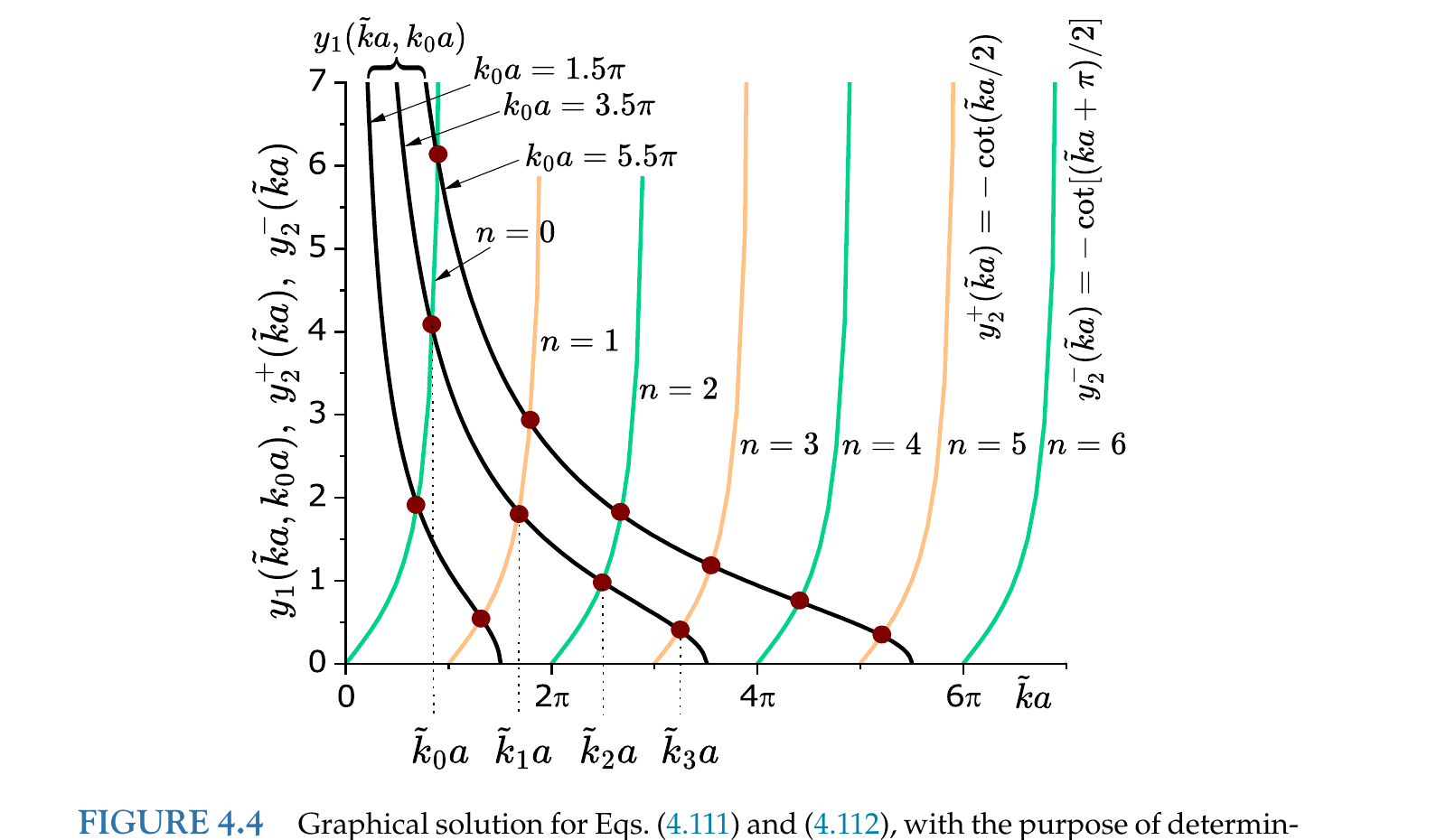
There is one solution at each crossing. The number of crossings, and therefore the number of energy levels, is
The brackets \(\lceil\ \rceil\) denote the ceiling function: it returns the smallest integer greater than or equal to its argument. Here \(\nu\) represents the number of bound-state energy levels in the well.
The quantum number is \(n=0,1,2,\ldots,\nu-1\).
Inside region II, the oscillatory solution contains \(\tilde{k}\). The graphical intersections select only certain values \(\tilde{k}_n\), one for each bound state. Since \(\tilde{k}^{2}=k_0^2-k^2\), each allowed \(\tilde{k}_n\) fixes the corresponding external decay constant \(k\) and hence the energy.
Thus the roots \(\tilde{k}_n a\) read from the region-II graphical solution become the negative energies \(E_n\). The result remains within the bound-state interval \(-V_0<E_n<0\).
The graphical intersections determine \(\tilde{k}_n a\). Substitution in the energy expression then converts each allowed intersection into one negative-energy bound state.
This page supports exercises on the two transcendental branches, their graphical intersections, the number of levels, and the energy spectrum.
- Use from this page: the two branches, \(y_1\), \(y_2^\pm\), \(\nu\), and the energy formula.
- Keep in the book: the full derivation of the two branches from the four matching equations.
- Good exercise balance: identify a graphical intersection before calculating its energy.
Use these anchors to build short exercises about finite-well quantization.
- Focus: the two branches and the resulting negative energies.
- Conceptual check: explain why a crossing represents an allowed state.
- Equation: \[\nu=\left\lceil\frac{k_0a}{\pi}\right\rceil\]
- Equation: \[\frac{E_n}{|V_0|}=\frac{(\tilde{k}_n a)^2}{(k_0a)^2}-1\]
- Boundary: use the graph and equations for first-step reasoning; use the book for numerical solutions.
- Typical task: count the levels and obtain a normalized energy from \(\tilde{k}_n a\).