Index
Chapter 4 · Item 4.8
Finite well: wave functions and penetration
Odd and even states in the three regions
8 / 14
Guided reading

After the allowed values \(\tilde{k}_n a\) have been found, the finite-well wave functions can be written separately in regions I, II, and III. Odd \(n\) produces an odd wave function about the center of the well; even \(n\) produces an even one.

Wave functions and probability densities
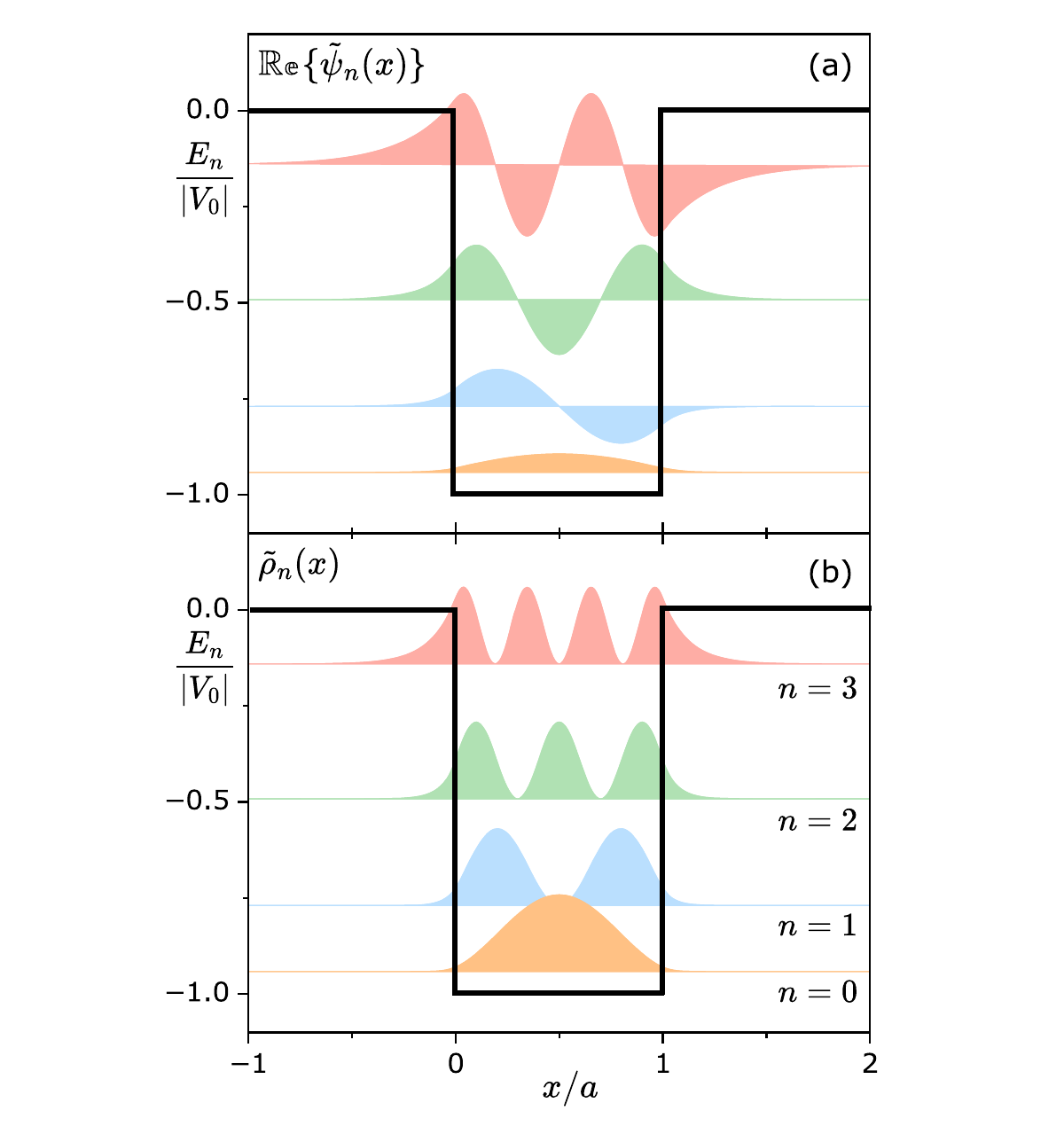
Book figure of finite-well wave functions and probability densities for several quantum numbers, with exponential tails outside the well.
Figure 4.5: real parts of the finite-well wave functions and their probability densities, aligned with the corresponding energy levels. For scaling, \(\operatorname{Re}\{\tilde{\psi}_n(x)\}=\operatorname{Re}\{\psi_n(x)\}/(10C)\) and \(\tilde{\rho}_n(x)=\rho_n(x)/(20|C|^2)\).
Penetration depth

The exponential factors are written with the penetration depth

\[l=\frac{a}{\left[(k_0a)^2-(\tilde{k}_n a)^2\right]^{1/2}}=\frac{\hbar}{\sqrt{2m|E_n|}}.\]

Thus \(kx=x/l\).

Odd \(n\): real part of the wave function

For odd \(n\), the real parts in the three regions are

\[\operatorname{Re}\{\psi^{\mathrm{odd}\ n}_{\mathrm I}(x)\}=2C\sin^2\left(\frac{\tilde{k}_na}{2}\right)e^{x/l},\]
\[\operatorname{Re}\{\psi^{\mathrm{odd}\ n}_{\mathrm{II}}(x)\}=-2C\sin\left(\frac{\tilde{k}_na}{2}\right)\sin\left[\tilde{k}_na\left(\frac xa-\frac12\right)\right],\]
\[\operatorname{Re}\{\psi^{\mathrm{odd}\ n}_{\mathrm{III}}(x)\}=-2C\sin^2\left(\frac{\tilde{k}_na}{2}\right)e^{-(x-a)/l}.\]
Even \(n\): real part of the wave function

For even \(n\), the real parts are

\[\operatorname{Re}\{\psi^{\mathrm{even}\ n}_{\mathrm I}(x)\}=2C\cos^2\left(\frac{\tilde{k}_na}{2}\right)e^{x/l},\]
\[\operatorname{Re}\{\psi^{\mathrm{even}\ n}_{\mathrm{II}}(x)\}=2C\cos\left(\frac{\tilde{k}_na}{2}\right)\cos\left[\tilde{k}_na\left(\frac xa-\frac12\right)\right],\]
\[\operatorname{Re}\{\psi^{\mathrm{even}\ n}_{\mathrm{III}}(x)\}=2C\cos^2\left(\frac{\tilde{k}_na}{2}\right)e^{-(x-a)/l}.\]
Odd \(n\): probability density in the three regions

The probability density is \(\rho_n(x)=|\psi_n(x)|^2\):

\[\rho^{\mathrm{odd}\ n}_{\mathrm I}(x)=4|C|^2\sin^2\left(\frac{\tilde{k}_na}{2}\right)e^{2x/l},\]
\[\rho^{\mathrm{odd}\ n}_{\mathrm{II}}(x)=4|C|^2\sin^2\left[\tilde{k}_na\left(\frac xa-\frac12\right)\right],\]
\[\rho^{\mathrm{odd}\ n}_{\mathrm{III}}(x)=4|C|^2\sin^2\left(\frac{\tilde{k}_na}{2}\right)e^{-2(x-a)/l}.\]
Even \(n\): probability density in the three regions
\[\rho^{\mathrm{even}\ n}_{\mathrm I}(x)=4|C|^2\cos^2\left(\frac{\tilde{k}_na}{2}\right)e^{2x/l},\]
\[\rho^{\mathrm{even}\ n}_{\mathrm{II}}(x)=4|C|^2\cos^2\left[\tilde{k}_na\left(\frac xa-\frac12\right)\right],\]
\[\rho^{\mathrm{even}\ n}_{\mathrm{III}}(x)=4|C|^2\cos^2\left(\frac{\tilde{k}_na}{2}\right)e^{-2(x-a)/l}.\]
Nodes and penetration

Odd (even) \(n\) corresponds to an odd (even) wave function with respect to the center of the potential. The number of nodes is \(n\); the probability-density minima represent those nodes. The exponential terms in regions I and III give a nonzero probability beyond the classical limits. A larger \(|E_n|\) gives a smaller \(l\).

Exercise-ready boundary

This page supports exercises on finite-well wave functions, probability densities, parity, nodes, and penetration depth.

  • Use from this page: the regional odd/even wave functions, \(\rho_n=|\psi_n|^2\), and \(\ell\).
  • Keep in the book: the full determination of the coefficients and normalization.
  • Good exercise balance: identify the parity of \(n\) before selecting the wave function.
Practice anchors

Use these anchors to build compact exercises from the finite-well wave functions.

  • Focus: parity, nodes, probability density, and penetration depth.
  • Conceptual check: explain why the external wave functions decay without vanishing identically.
  • Equation: \[l=\frac{\hbar}{\sqrt{2m|E_n|}}\]
  • Equation: \[\rho_n(x)=|\psi_n(x)|^2\]
  • Boundary: use the displayed regional forms for setup; use the book for normalization details.
  • Typical task: choose the odd or even form and identify its nodes and tail.
Source note: Original auxiliary summary based on Chapter 4 of Mario Reis, Quantum Mechanics, Elsevier, 2026. Consult the original book for complete derivations and exercises.